Is this a terrible idea? It can’t be, it’s in Peep Show. This is the question I’m left pondering as I consider the social, political and philosophical utility of a post on this subject. However, I then remind myself of how the sitcom has become a cultural phenomena comparable to Friends or Only Fools and Horses that is presented as a hyperreal simulation of contemporary English society – both the cult popularity of Peep Show and its philosophical ‘contents’ warrant further study. Throughout this short post, it will be argued that Peep Show is presented as a hypereal simulation of the ‘real’ experience of contemporary English society through the adoption of point-of-view camerawork. Furthermore, the sitcoms defining use of the characters’ interior monologue devoids the contents of their speech of meaning resulting in an ‘implosion of meaning’. In order to demonstrate this, we will first introduce Peep Show and define it as a ‘cult’ sitcom, followed by an exploration of how the cinematography of Peep Show defines the sitcom as a hypereal simulation. Finally, we will reflect on how the deployment of an interior monologue devoids the characters’ communication of information, thoughts and emotions of meaning which subsequently results in a form of nihilism labelled ‘transparent’ by Jean Baudrillard.
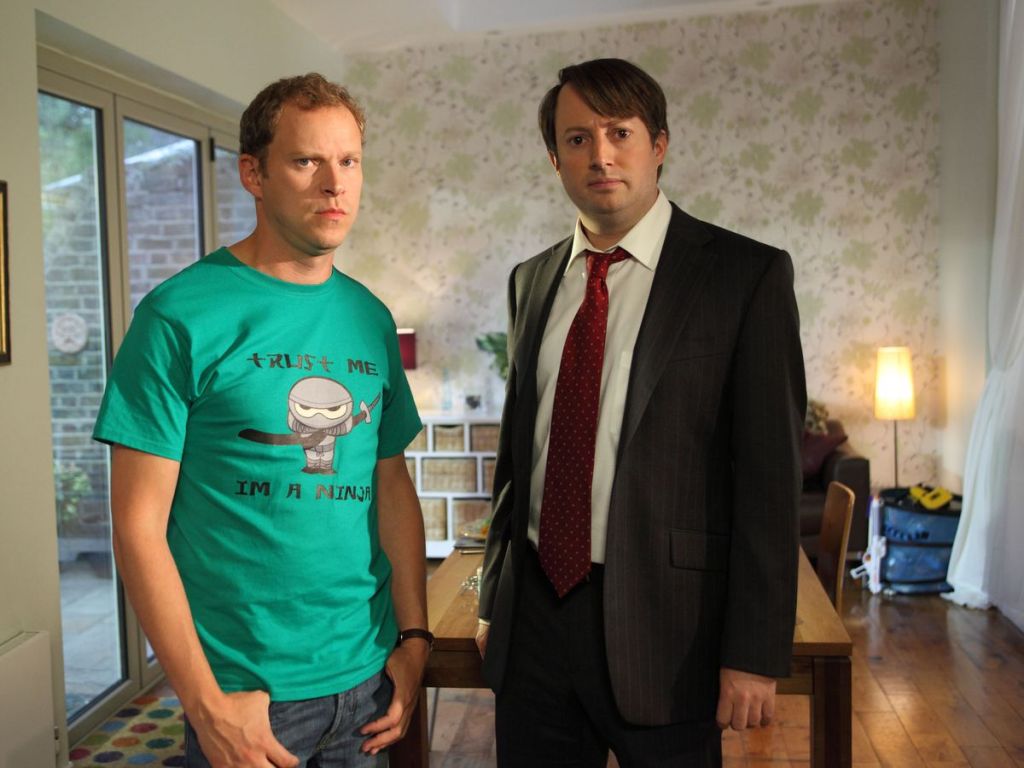
Peep Show, written and created by Jesse Armstrong and Sam Bain, stars Mark Corrigan (David Mitchell) and Jeremy Usbourne (Robert Webb) as juxtaposed, yet codependent, flatmates. The sitcom is premised upon the audience ‘peeping’ into the daily lives of the characters to reveal their experiences of romance, friendship, employment (or lack thereof) and family relationships. Mark and Jeremy are presented as morally ambiguous, self-critical and a recent video labelled goes to the extent of labelling Mark as a psychopath. Mark and Jeremy experience their lives alongside a diaspora of other individuals: Super Hans (Matt King) – a ‘drug-addled’ and maninacial companion who often reduces the mundane to the ridiculous, Sophie Chapman (Olivia Coleman) Mark’s first romantic interest, jilted wife and mother to his child, Big Suze (Sophie Winkleman) – Jeremy’s romantic interest and object of fantasy, and Alan Johnson (Robert Pattinson) – Mark’s boss, companion and ‘one-time’ romantic interest and a recurring nemesis for Jeremy. Mark and Jeremy’s lives are depicted as concurrently progressing and regressing and the mastery of Peep Show‘s narrative is the presentation of the ridiculousness of contemporary English society. Their experiences are relatable to the ‘average’ viewer, yet the ever present conflict between action and thought and the reduction of the mundane to the ridiculous depicts the everyday as a ‘comic tragedy’. The characters strive towards a spectral ‘happiness’ and ‘fulfilment’ and repeatedly discover that the aforementioned is elusive, and, in fact, both Mark and Jeremy regress socially, financially and emotionally throughout the course of events depicted in the sitcom.
In addition, whilst not enjoying overwhelming popularity during its period on-air (2003-2015), Peep Show has ascertained cult popularity in recent years. As Umberto Eco has argued in Faith in Fakes a cult may be defined as:
“The work must be loved, obviously, but that is not enough. It must provide fans with a completely privately furnished world so that they can quote characters as if they were aspects of the sectarian world, a world about which one can make quizzes and play trivia games so that adepts of the sect recognise each other through a shared experience” (Eco, 1998: p198)
Many will note that Peep Show enjoyed notable success in recent years amongst university students who created a ‘privately furnished world’ around the sitcom that included memes, themed quizzes hosted by former cast members and even a concert hosted by Matt King as Super Hans! This sect is both internally consistent and allows members to identify each other through their shared experiences of the sitcom. I frequently recall, during my time at university, that my friends and I would communicate almost exclusively using Peep Show quotes without the need to acknowledge that they are references to the sitcom.
The popularity of Peep Show resists a genealogy, however the pleasure seeking and self-critical nature of the show mirrors generalised trends in higher-education institutions: “Many of the teenage students I encountered seemed to be in a state of what I would call depressive hedonia. Depression is usually characterised as a state of anhedonia but the state I’m referring to is constituted not by an inability to get pleasure as it to anything except pursue pleasure” (Fisher, 2008: p21-22) Jeremy is presented as a hedonist, as financially irresponsible and morally ambiguous to the extent in which he is able to be adulterous with his recently wedded wife. He is unable to envision happiness beyond the pleasure principle, and his self-critique on his pleasure seeking characterises his actions as depressive hedonism. On the other hand, Mark’s character mirrors a further trend in higher-education: “The old disciplinary segmentation of time is breaking down. The carceral regime of discipline is being eroded by the technologies of control, with their system of perpetual consumption and continuous development” (Fisher, 2008: p23). Mark frequently recognises the essential ‘pointlessness’ of his role at JLB Credit. For example, he mentally escapes to pretend he’s flying a Spitfire or entering data for MI5. As the carceral regime decays at JLB Credit, Mark dissects his function as subject of that institution through make belief games. In addition, Mark’s continuous consumption of products diacciates him from the breakdown of the disciplinary framework. For example, in an episode entitled Jeremy at JLB, Mark purchases a new sofa he labels “the creamy white elephant”. This elephant provides an escape from the mental instability perpetuated by contemporary society. To briefly summarise, the popularity of Peep Show for students in higher-education institutions may be, in part, that it functions as a hologram of the decay of the post-disciplinary framework. As Baudrillard contests:
“The TV studio transform you into holographic characters one has the impression of being materialised in space by the light of projectors, like translucid characters who pass through the masses (that of millions of TV viewers) exactly as your real passes through the unreal hologram without encountering any resistance – but not without consequence: having passed through the hologram renders your hand unreal as well” (Baudrillard, 1994: p105)
In Simulacra and Simulation Baudrillard defines a simulation as: “abstraction is no longer that of the map, the double, the mirror or the concept. Simulation is no longer that of a territory, a referential being, or a substance. It is the generation by models of a real without origin or reality: a hyperreal (Baudrillard, 1994: p1). The difference between singularity and otherness is no longer definable, the map and the territory that it references are no longer separate. As Baudrillard further adds: “The real is produced from minutraised cells. Matrices and memory banks, models of controls – and it can be reproduced an indefinite number of times from these” (Baudrillard, 1994: p2). In Peep Show, the reference is dissected through the adoption of point-of-view cinematography and this can be initially demonstrated by the title sequence of the sitcom. Throughout the aforementioned, the audience is presented with a first-person experience of a suburban high-street as the characters advance towards an electrical shop typical of the early 2000s. Subsequently, the audience observes Jeremy and Mark looking directly into the camera which then pans across a television in the shop window showing the flatmates captured by a video camera on display. As Mills notes in Paranoia, Paranoia, everybody’s coming to get me “it becomes clear that what we are witnessing is point-of-view shots, and that the whole series is shot from the perspectives of the characters within it” (Mills, 2008: p51). In the majority of sitcoms and television the characters and audience can be distinguished from the exterior, however in Peep Show the distinction is blurred. The events unfold by the audiences as the usual chain of causation within a sitcom or television – i.e. characters makes a joke and another characters reacts – disintegrates. We, alongside the character, make the joke and experience the other characters reaction which often causes us to humorously react and this chain of causation provides us with a ‘reference’ through which we experience the medium of the sitcom. This reference forms a series of expectations that form our expectations of television shows of the same genre. In the title sequence, we cannot reference the subject of the scene or comedy, our perspective is reflected as if we were experiencing the scene of ourselves. The disintegration of the ‘reference’ is evidenced in an episode entitled Wedding, Mark emerges from his bedroom to find Super Hans heavily inebriated on the hallway floor. We feel Mark’s dissatisfaction at his ‘unofficial stag night’ alongside him, and the sense of dread that the situation presupposes for Mark is shared. The comedic experience is simulated by allowing us to experience the events alongside the character simultaneously as we further fail to distinguish the subject of the scene or comedy. In Peep Show, the point-of-view cinematography, which begins with the title sequence and continues throughout the sitcom, delineates the referential relationship that has been established for the genre.The Croydon of Peep Show functions as a space of the hyperreal. As Mills notes: “The programmes novel shooting style means that the ways in which audiences are positioned in relation to the characters are different from those in most sitcoms, and this has consequences for how the jokes work, and the pleasures an audience may take from laughing at them” (Mills, 2008: p53).
Meaning implodes in the interior monologues of Peep Show. As Baudrillard contends: “Information devours its own content. It devours communication and the social” (Baudrillard, 1994: p80). In Peep Show, this ‘implosion of meaning’ is demonstrated through the adoption of an interior monologue. The use of the aforementioned creates a direct juxtaposition between the exterior reality of the characters and the interior reality of their motivations whose meaning is transcended by the need for social acceptability. For Mark, the interior monologue remains a resolutely private sphere that fails to comprehend and recognise the rules of social acceptability. For example, in an episode entitled Warring Factions, Mark ponders: “Maybe nobody minds about things as much as me” which evidence his inability to recognise the subjective limits of what is considered to be socially acceptable. This lack of recognition arises from his continuous assessment of his own motives and his perceived emotional responses that what others may, or may not, ‘mind’ , thus revealing a contemporary example of the Foucauldian Panopticon. Mark ‘stages’ his speech in a manner in which he perceives social acceptability, however the adoption of an interior monologue reveals that this ‘staging’ is based on little more than his perception. For Jeremy, the interior monologue functions in a very similar manner, however the Panoptic effect is considerably less pronounced which frequently results in a less notable distance between the exterior reality and the interior reality of his motivations. For example, in an episode entitled Holiday, Jeremy instinctively takes a considerable bite from a partially barbecued dog leg proclaiming that it is undercooked turkey in order to maintain the illusion that the dog is lost and it had not been accidentally slain by his own hand. Mark displays an innate ‘paranoia’ at the consequences of his actions, whereas Jeremy allows his interior motivations to be broadcast externally in order to serve his own ends – the desire for a continued sexual relationship with the dogs owner. Exterior actions are ‘staged’ for Jeremy, but in a less pronounced manner. Jeremy’s actions are thereby motivated by the male hetrosexual ideal to be perceived as a sexual conquerer, which is viewed as a socially acceptable role amongst his acqutances. As Mills notes on the use of the interior monologue:
“Peep Show suggests that the interior is a more ‘truthful representation of the characters, and we are meant to accept what Mark and think is more representative of their true selves than what they say. However, this programme also demonstrates that Mark and Jeremy do not believe this, for them, their instinctive reactions are something to be interrogated … and denied if they fail to conform to the socially acceptable way of behaving” (Mills, 2008: p58)
The use of an interior monologue in Peep Show reveals not only the juxtaposition between the external reality of Mark and Jeremy’s actions and their interior motivations, but further demonstrates that they strive towards an idyllic social acceptance that is without codified reference. Their idea of social acceptance is without tauntological proof. The interior monologue does not only communicate the commonly interpreted messages of cynicism or juxtaposition, rather, it exhausts itself in a subjective Mobian circle over what is considered socially acceptable for Mark and Jeremy individually. A meaningless word-game. We may expect that an interior may expand the social by externalising the characters interior motivations, however a sustained analysis revealed that the communicated ‘information’ – the ‘hidden’ desire for social acceptability – is meaningless. The interior monologue is revealed to be a meaningless medium which, as Baudrillard notes, “the definition and distinct action of the medium can no longer be determined” (Baudrillard, 1994: p82).
As a result of the adoption of a an interior monologue and the subsequent ‘implosion of meaning’, Peep Show presents its audience with a hyperreal conception of nihilism. As Baudrillard contests: “Today’s nihilism is one of transparency, and it is some sense more radical, more crucial than in the prior and historical forms, because this transparency, this irresolution is indissolubly that of the system, and that of all the theory that still pretends to analyse it” (Baudrillard, 1994: p159). Transparent nihilism is evidenced in the title of the final episode of Peep Show – Are We Going To Be Alright? Faced with the breakdown of relationships, employment and friendships, Mark and Jeremy face a future that reflects the treachourness of life in a contemporary English society. However, rather than internalising their anxiety, the adoption of an interior monologue renders their anxiety visible and transparent. The values that Mark and Jeremy adopted at the outset of the series, i.e. Mark’s desire for a stable relationship with Sophie or Jeremy’s desire to become a successful musician, have been revealed to be baseless and beyond the reach of the characters and we, the audience, experience the protagonists uncertain nihilism concurrently.. As Baudrillard notes, this ‘sinister’ nihilism extends beyond political and economic nihilism and delineates the possibility of resistance. The interior ‘space’ of resistance is rendered visible by the Panoptic gaze and as Foucualt teaches us – what is known, can be governed. To briefly summarise, the adoption of an interior monologue engulfs Mark and Jeremy in ‘transparent’ nihilism that consumes resistance.
In addition to this ‘sinister’ and ‘transparent’ nihilism, Peep Show presents the audience with a troubling portrayal of disability. As Bolt notes in Pretending to be a normal human:
“In Peep Show the word choice of the protagonists is recurrently disabilist and often invokes flash representations of disability that accord with the fleeting nature of the disabled characters” (Bolt, 2016: p754)
The majority of the diabilist language employed throughout Peep Show specifically relates to its portrayal of mental health and the labelling of events as ‘mental’. For example, in an episode entitled The Interview, Mark labels a cartoon that he has drawn for Sophie as ‘mental’ whereas in an episode entitled On the Pull Jeremy states that ‘maybe he can get into Peter Gabriel and go mental’. Here, the choice of the term ‘mental’ is consitely used to describe an event or individual that is either unusual or uncontrollable. Consequently, Peep Show’s selection of vocabulary in the aforementioned episodes reinforces stereotypical notions of behaviours commonly associated with mental illness.
To conclude, I have presented an argument which suggests Peep Show can be interpreted as dramatisation of simulation. However, I initially argued that whilst Peep Show’s recent popularity resists a simple genealogy, its popularity amongst specific groups may arise from the narratives similarity to specific trends with higher-education. Subsequently, it was demonstrated that the adoption of point-of-view cinematography presents the audience with a simulation of the comedic experience. Furthermore, it was argued that the use of an interior monologue throughout the series causes meaning to implode in the sitcom. Finally, I presented the consequences of such an implosion as a form of ‘transparent nihilism’ and noted Peep Show’s troubling and frequent adoption of diabilist language. We must recognise that the coveted sitcom consistently adopts, however satrically, disablist language and reflect on the presentation, amongst certain groups, of Mark and Jeremy as icons. It is my hope that after reading this post, one question remains for the reader: Should I watch, or continue watching, Peep Show? In short, my answer is yes. However, it is my hope that the audience disregard any causal interpretations, such as the sitcom is relatable or presents us with a mirror for our own lives, but rather view Peep Show as a dramatisation of a hyperreal simulation and revisit Baudrillard accordingly.
Bibliography
Baudrillard, J., (1994) ‘Simulacra and Simulation’ ., Trans by Faria-Glaser, S., The University of Michigan Press., pp1, p2, p80, p82, p105, p159
Bolt, D., (2016)., ‘Pretending to be a normal human: Peep Show, sitcom, and the momentary invocation of disability’ ., Disability and Society., Vol.31., No.6., p745-757
Eco, U., (1998) ‘Faith in Fakes: Travels in Hyperreality’., Vantage., p198
Fisher, M., (2008)., ‘Capitalist Realism: Is There No Alternative?’., Zero Books., pp21, 22, 23
Mills, B., (2008)., ‘Paranoia, Paranoia, everybody’s coming to get me’: Peep Show, sitcom, and the surveillance society’., Screen., Volume 49., Issue 1., pp51-64
 After the eerie: reflections on Year Omega